
Charleston Landscaping, From Downtown Courtyards to Live Oak Lots
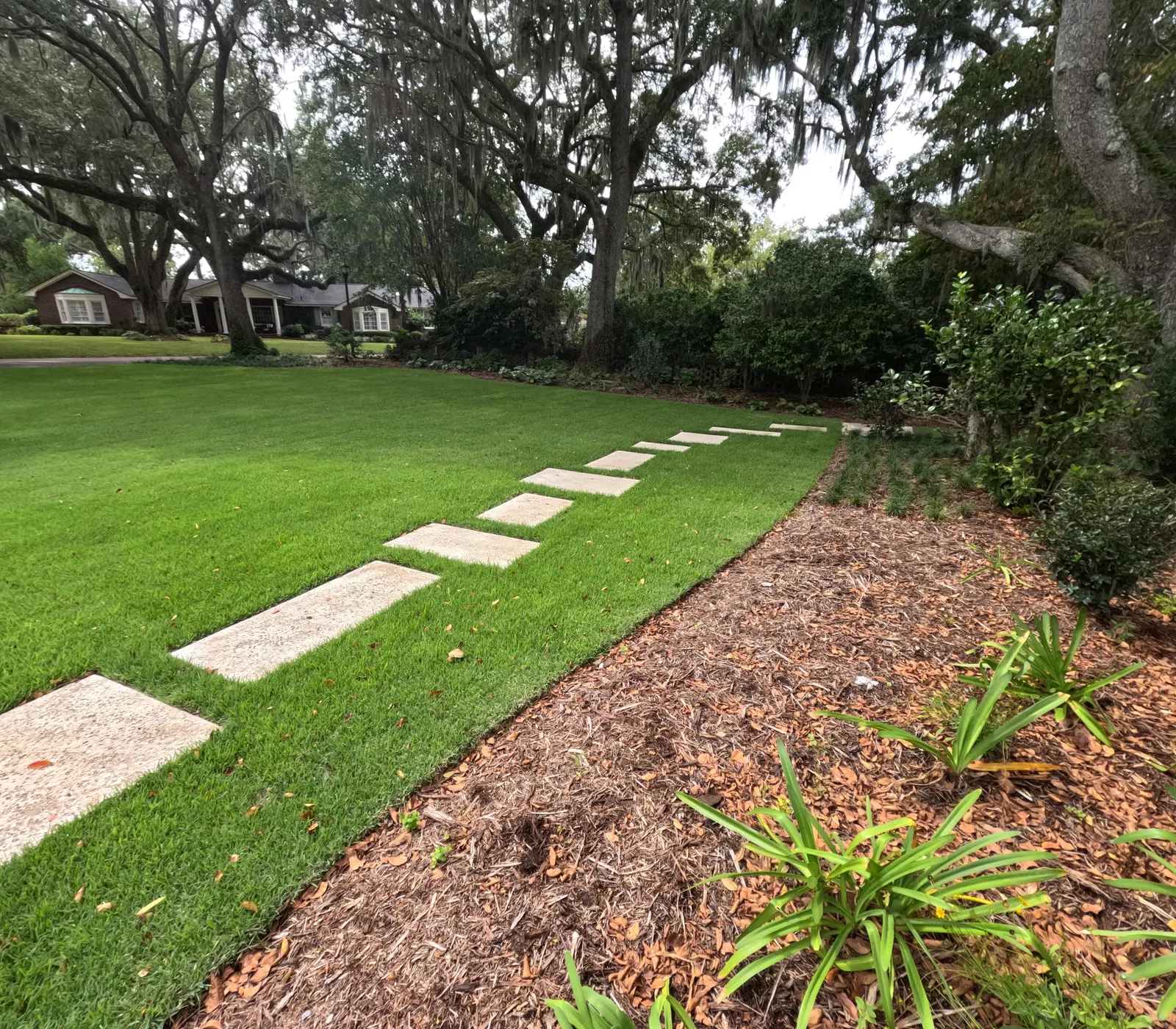
Local & Family-Run
Designed and Built by Doug and Zach, With Our Own Crew
Cramers Landscaping is a family company. Doug Cramer has worked in landscaping his whole life, with more than 30 years of experience, and his son Zach is our licensed residential builder. Doug and Zach design every project themselves, and our own crew builds it.
We’ve worked in many different neighborhoods downtown and around the Charleston area. Charleston yards ask for very different things: a downtown courtyard needs every square foot to work, and a lot under live oaks needs care around the trees. The projects below are all real Charleston jobs.
A Downtown Yard That Stopped Flooding
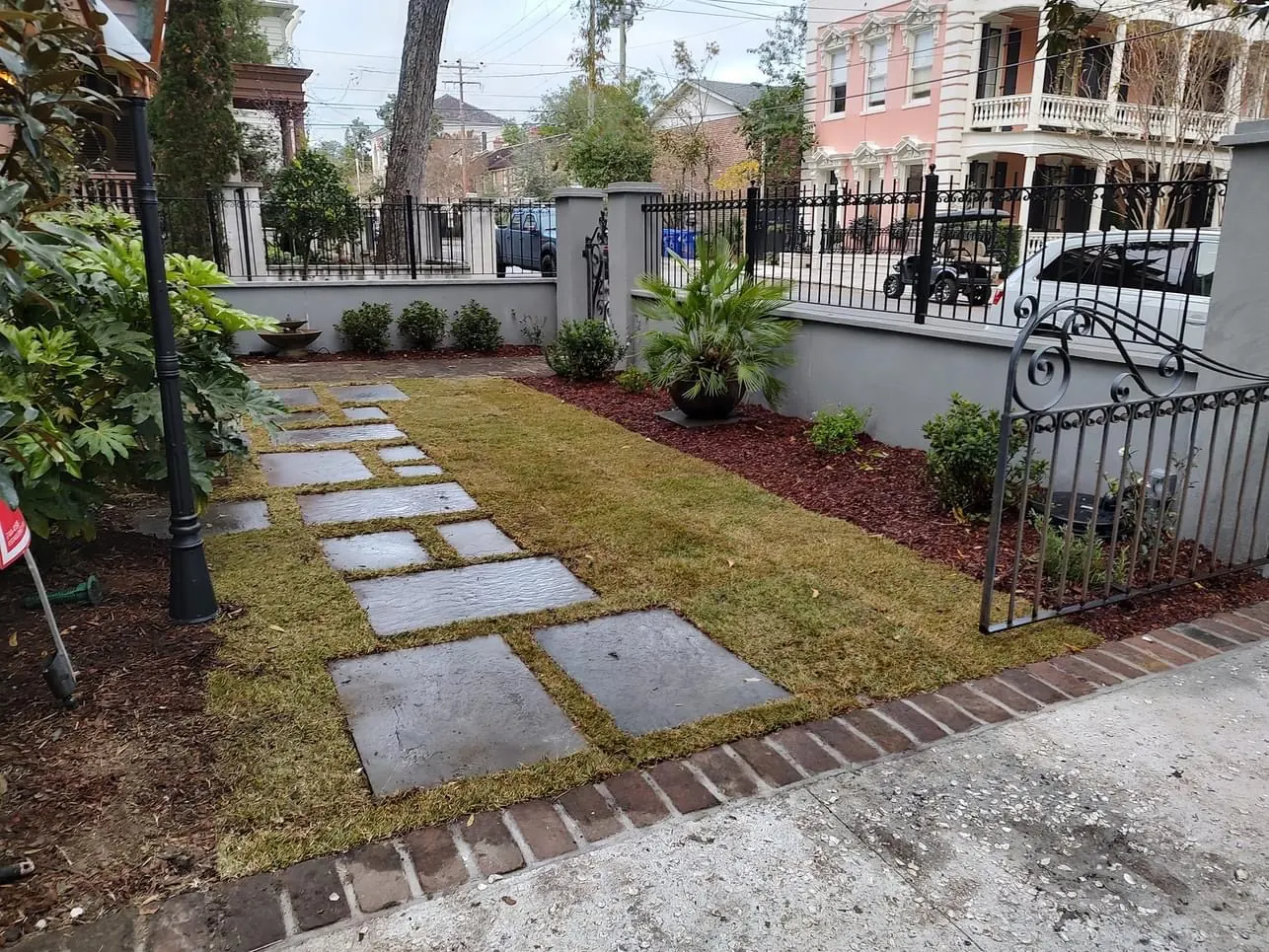
This downtown Charleston homeowner had flooding problems. We took down her iron fence, built a stucco wall, and put the fence back on top of it. Then we modified her gates so she can seal them against water coming in.
We added a basin and a pump to move any water out of the yard, and finished by redoing the landscaping with turf, plants and mulch. The photo shows the finished wall with the iron fence back on top.
She still has us back to prune and to clean her fountains. We’re not a maintenance company, but we do come back for clients whose yards we built.
More on how we handle water: yard drainage.
Small Downtown Yards, Made Usable
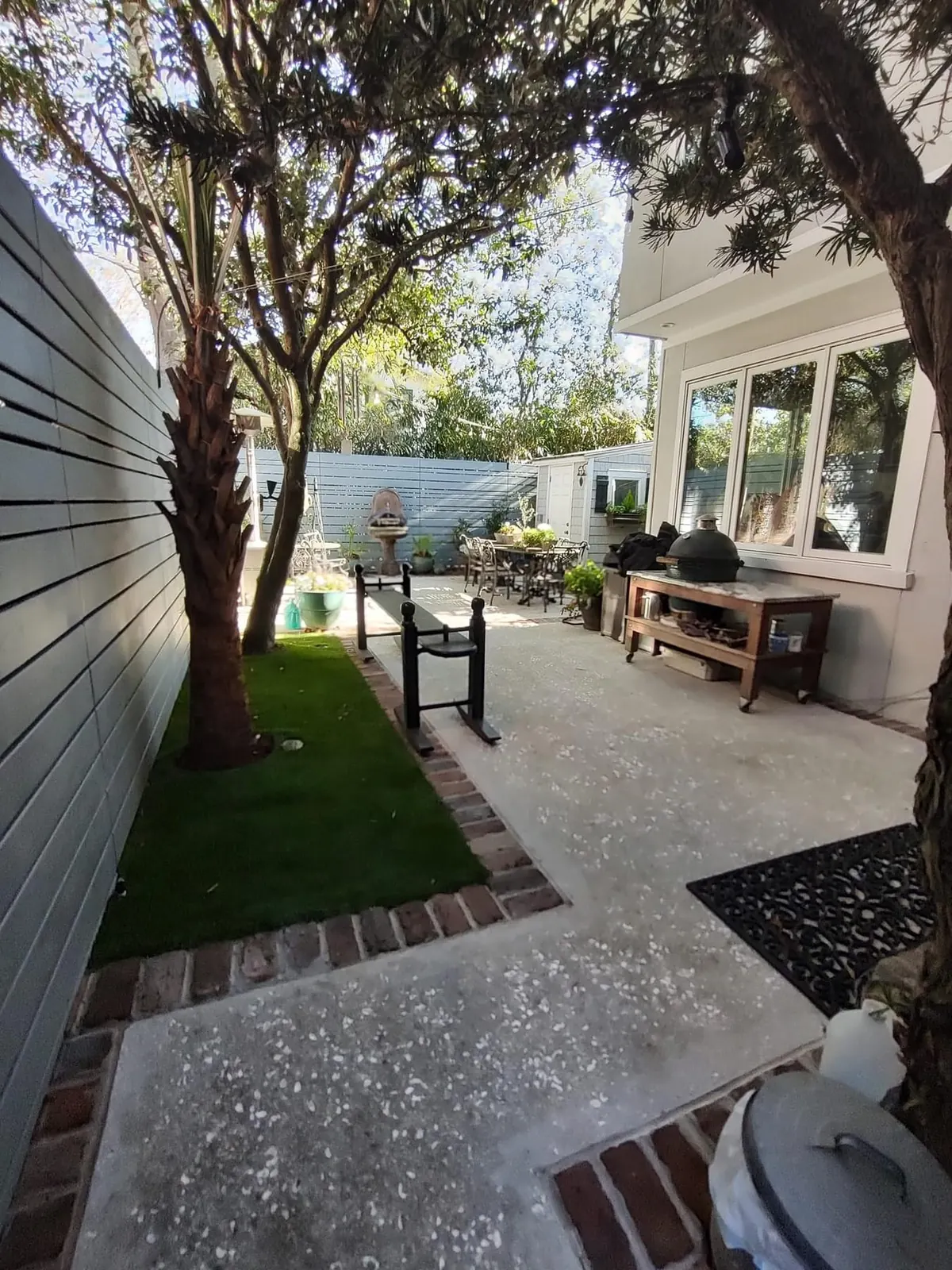
A courtyard with a fountain
Downtown yards are small, so every square foot has to earn its place. The goal here was a yard that is usable and low maintenance without losing the garden. We poured tabby concrete with a brick border and laid artificial turf, then brought the garden back in: a fountain with an automatic filler so it keeps itself topped up, plants including the palm, a slatted fence and landscape lighting.
For the same client we also fixed the metal gate, and repaired the common-area retaining wall after a delivery driver hit it.
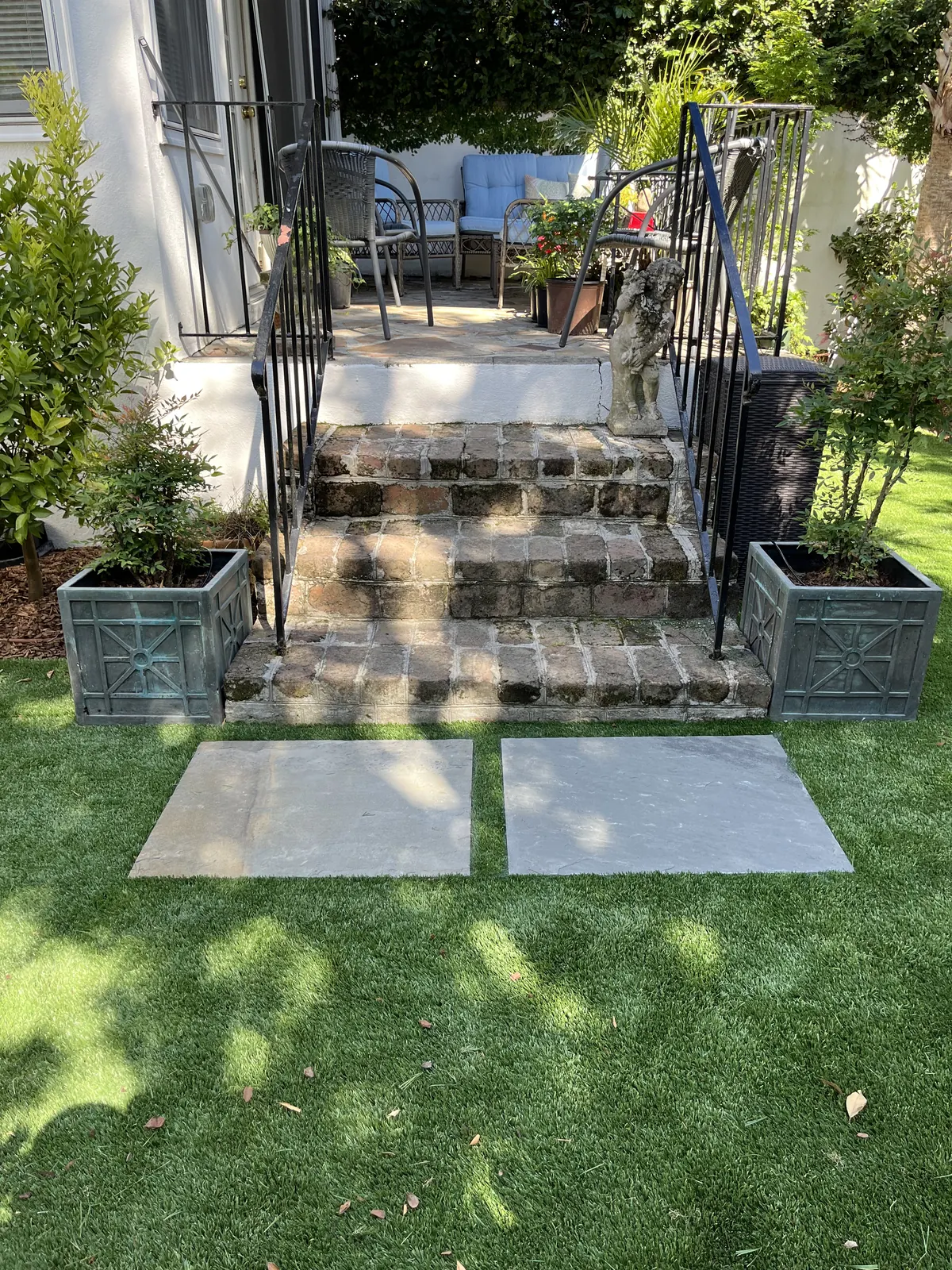
A small backyard for a dog
Another downtown backyard, this one made usable for the owners and their dog. The lawn is artificial turf, with bluestone stepping stones across it. We cleaned up the beds and added some plants around the edges.
Turf earns its money where grass keeps failing: deep shade, a dog run or a narrow side yard. It starts from $13 per square foot, including the base preparation.
A New Front Yard Under the Live Oaks
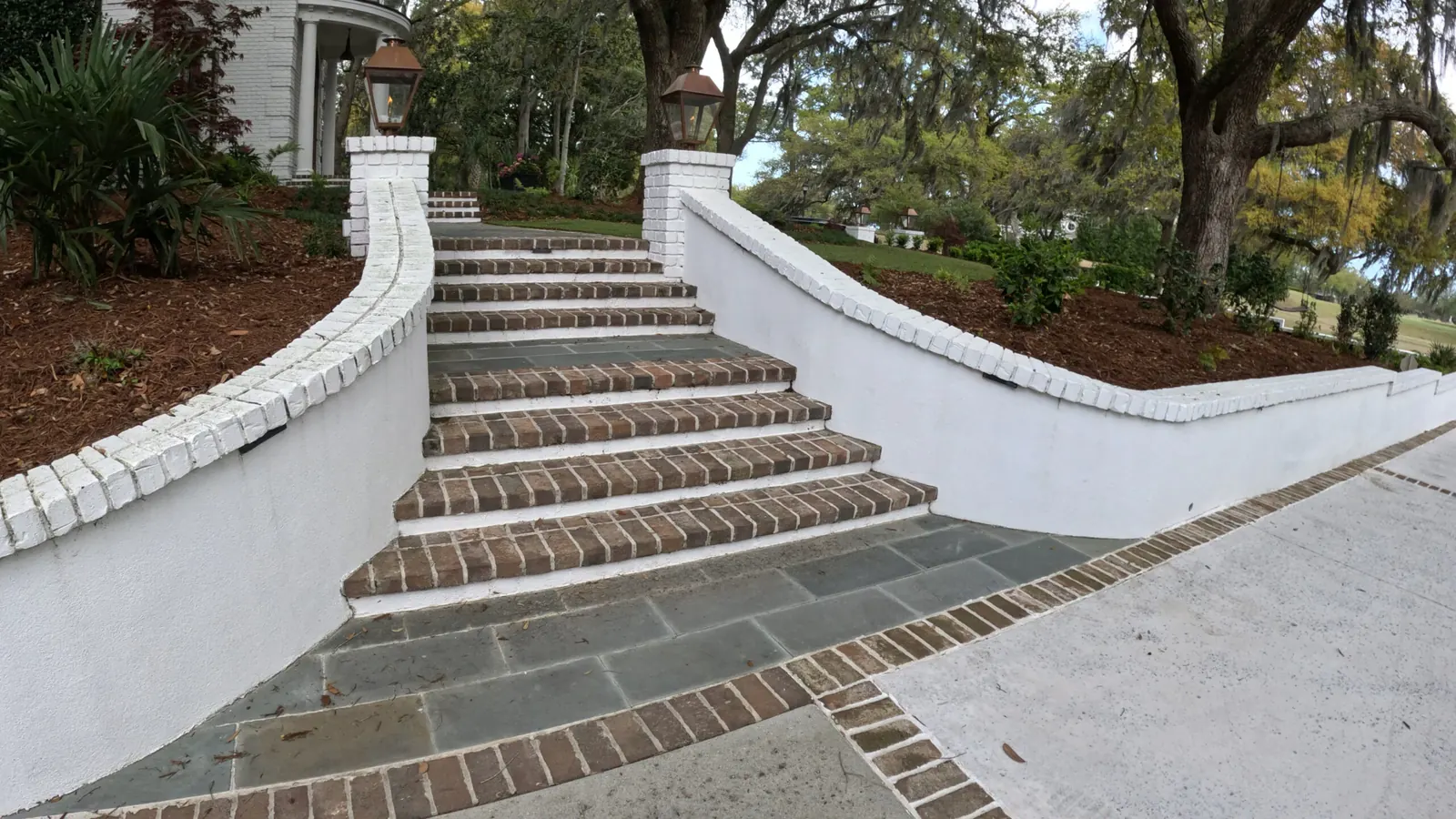
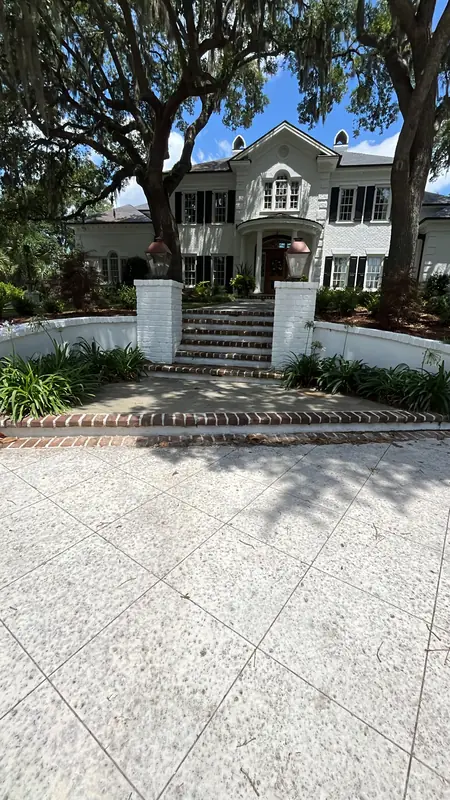
The hard part of this job was the new retaining wall. It had to tie into the old one so that you can’t tell where one ends and the other begins. Brick steps with bluestone landings climb through it, with gas lanterns on the columns at the top.
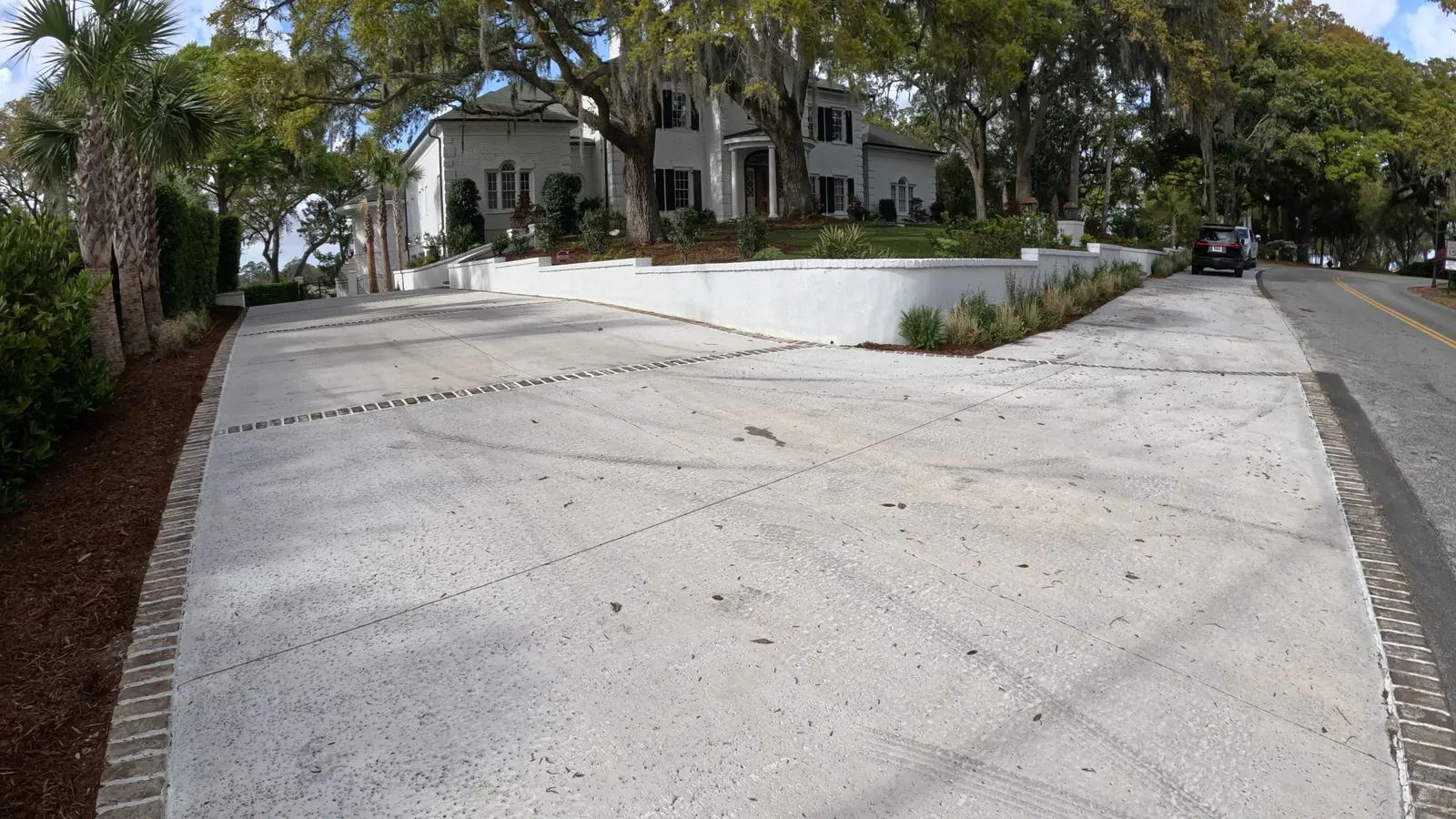
Below the wall we poured a salt-void driveway with a brick border, and a salt-void entrance with a diamond pattern. Salt-void is one of the finishes that suits an older home, and it looks good for the money. The beds along the wall are new plants and mulch, with irrigation running under all of it that you never see.
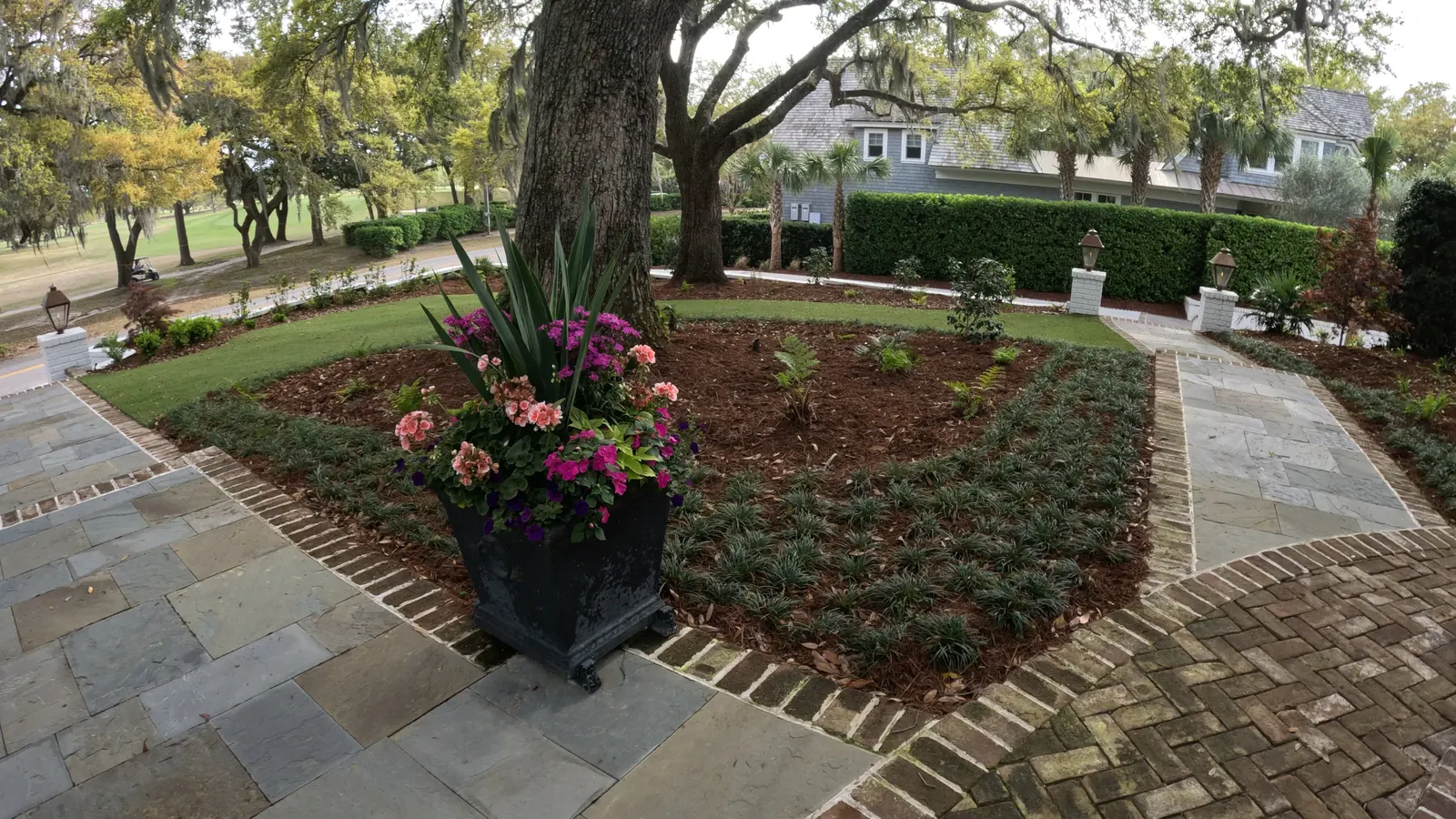
The walks are bluestone edged in brick, lit with landscape lights, and the whole front yard is artificial turf. All of it was built around live oaks. We were careful working near them and took extra precautions to make sure the trees stayed healthy through the whole process.
More Charleston Projects
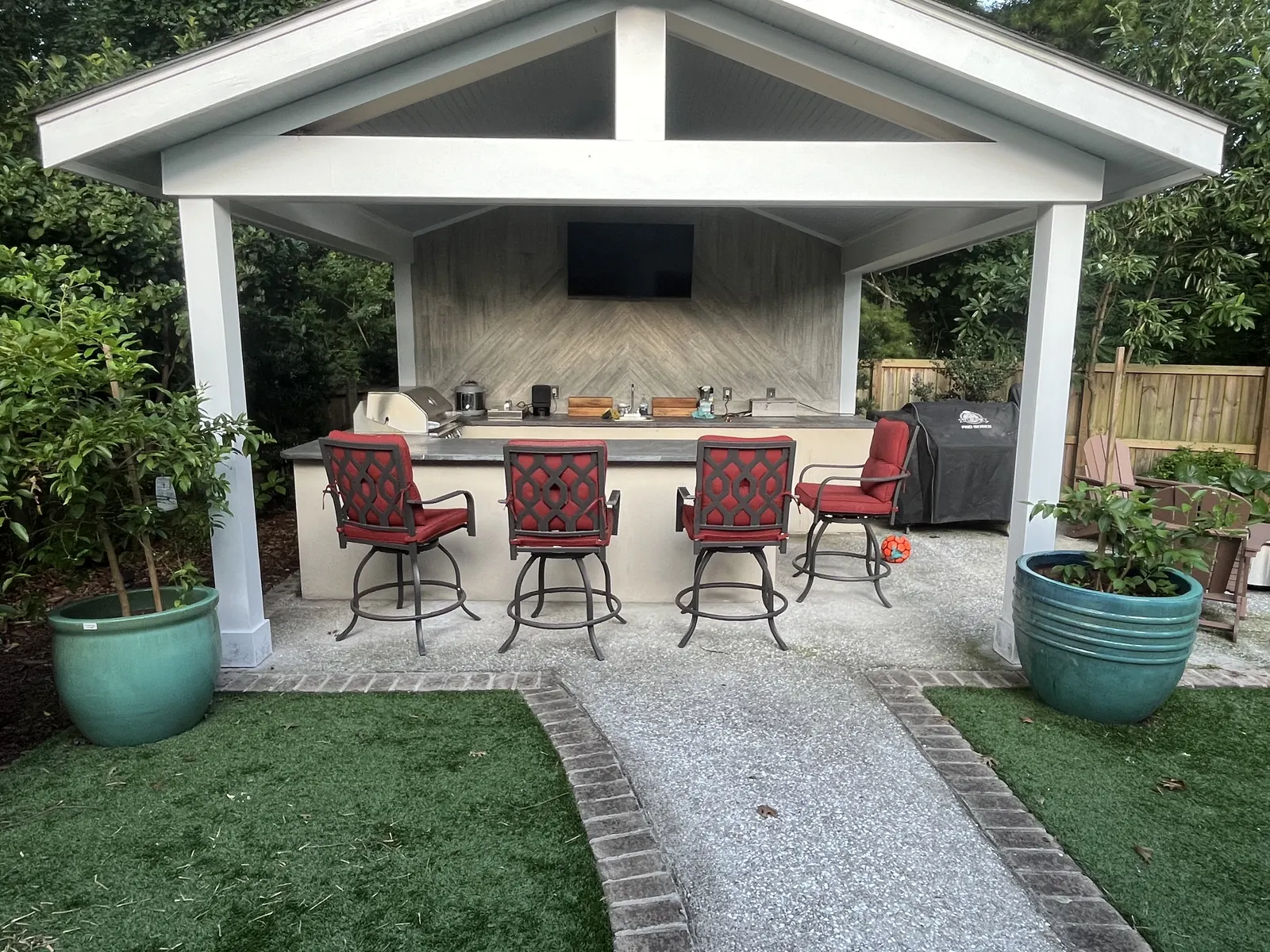
A low-slope gable pavilion
This pavilion has a low-slope gable, which gives it an Arts and Crafts feel, blended with some modern materials: Hardie trim, a tile back wall and a stucco and concrete kitchen. The yard is tabby concrete with a brick border and artificial turf, planted with citrus trees in pots, loquat trees and Japanese maples. Pots like those want their own irrigation zone, because they dry out far faster than beds.
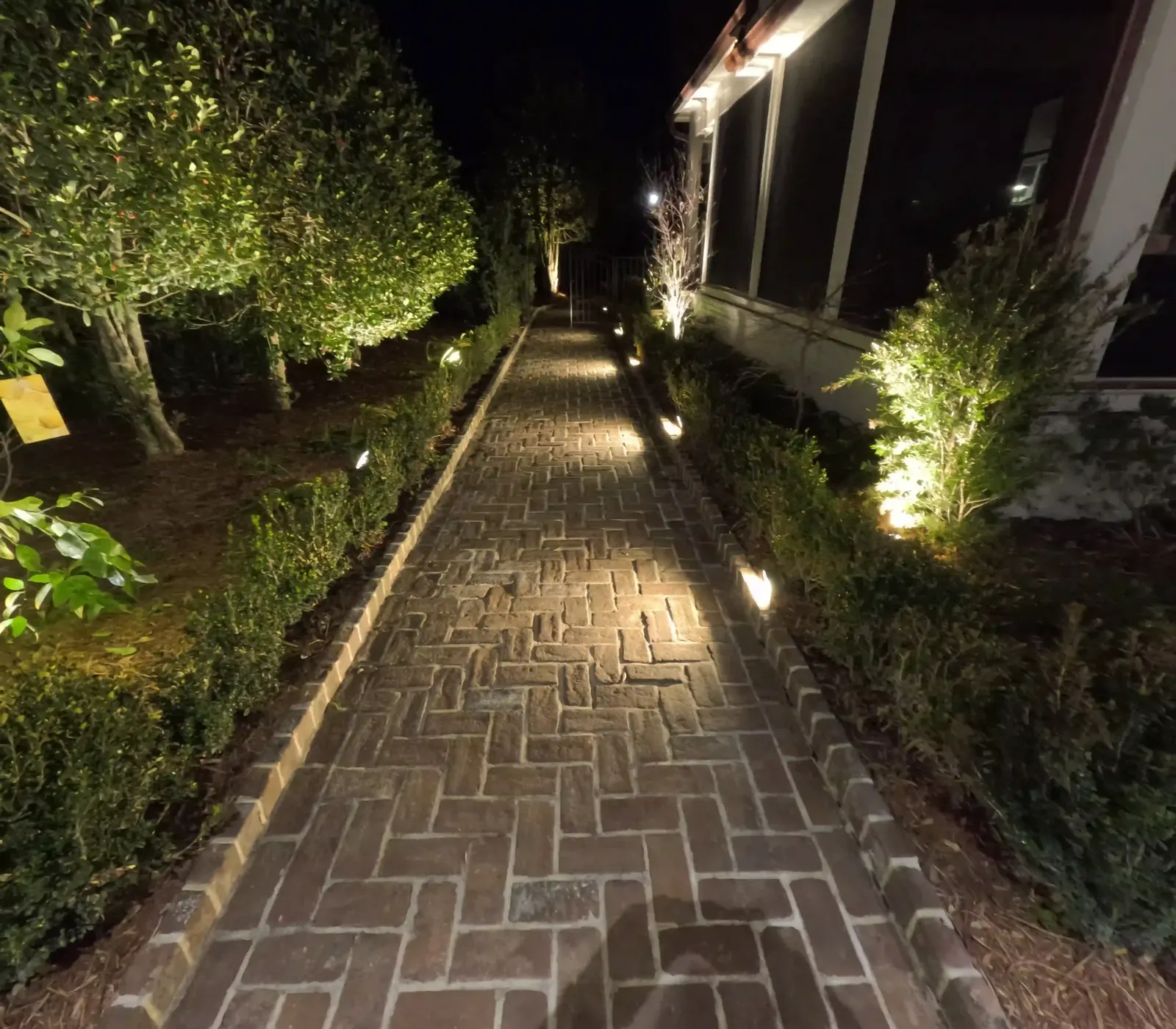
A brick walk, lit at night
After dark, this Charleston property is all about the lighting. Path lights and uplighting run the length of a herringbone brick walk, through plantings that fill in on both sides. We light paths and steps first, because that is the safety case, then trees and the house itself. The same project added a pavilion, artificial turf in the backyard and zoysia out front.
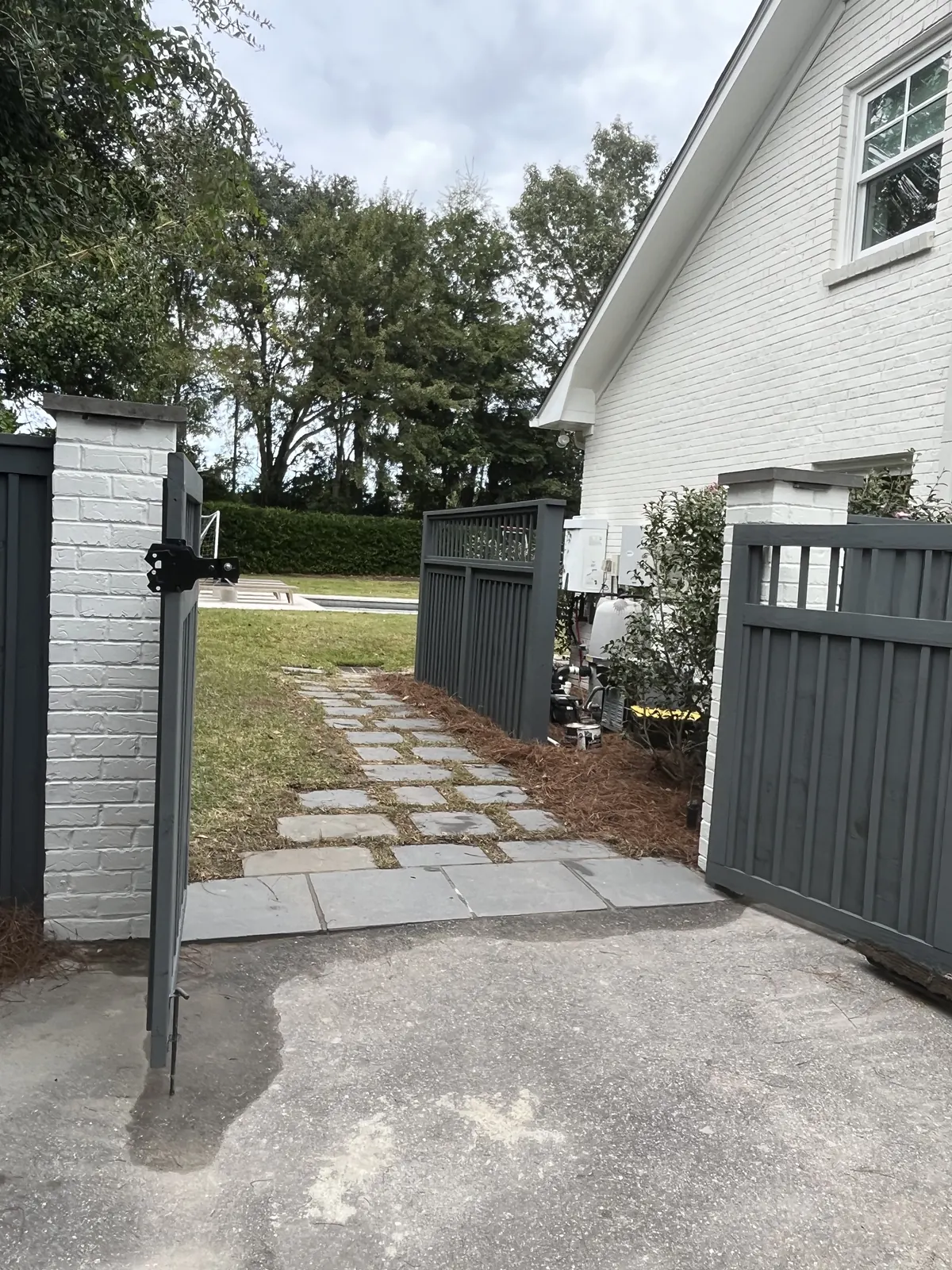
An elevated entrance
This entrance used to be a normal fence. We built the gates, the fence and the brick columns to turn it into a proper elevated entrance. The detail that matters is one you can’t see: we add a metal frame to the gates, because without one a double gate bows and won’t sit perfectly in line over time.
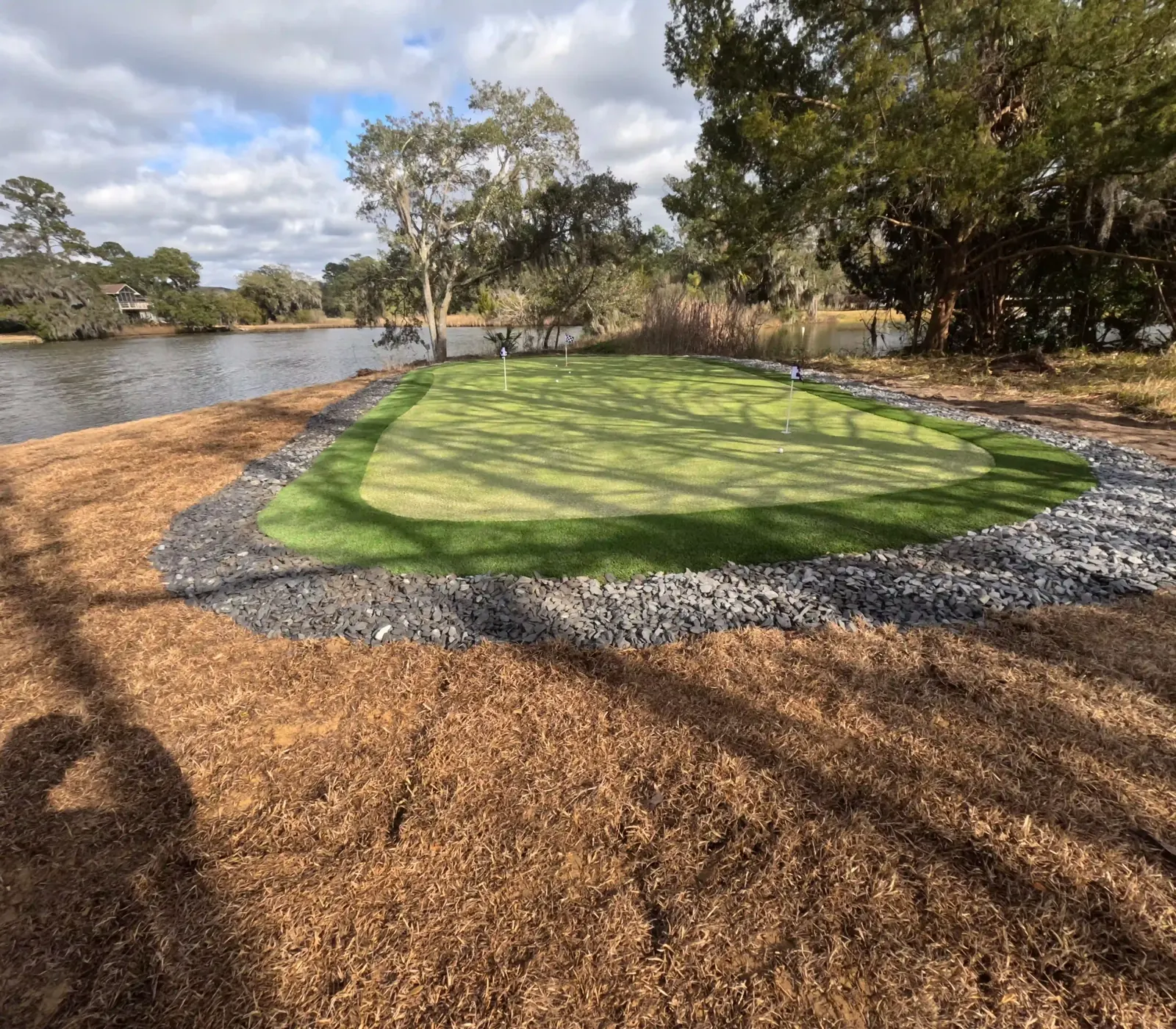
A waterfront putting green
An artificial turf putting green on the water, with three cups, a band of taller turf around the putting surface and a slate border along the edge.
Work for MUSC
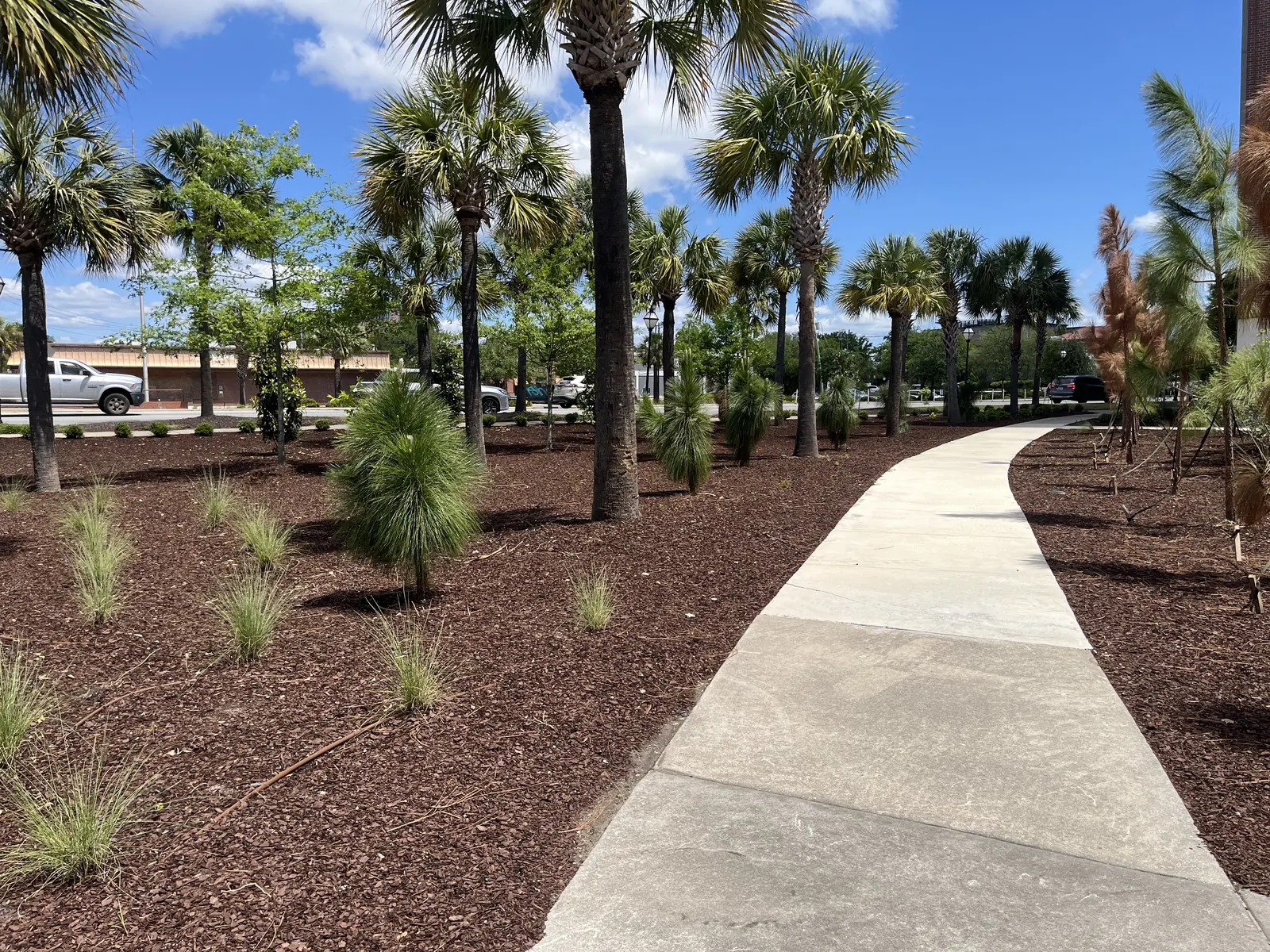
Our focus is residential, but we also do a lot of work downtown for MUSC, mostly concrete and plants. The planting and sod in this photo is some of it. Our concrete is poured in-house, at the thickness you paid for, with the mesh, rebar and joint spacing done properly.
Building in Charleston
Two things shape most Charleston projects: water and trees. The area gets roughly 52 inches of rain a year and the water table is high, so water pools easily. That is why drainage and grading get sorted out before a patio or a structure goes on top. The ground should fall about six inches over the first ten feet away from the foundation.
The City of Charleston protects grand trees, which are trees 24 inches or more in diameter, not counting pines and sweet gums. They can’t be removed without a permit, and they need a barricaded protective zone during construction. It matters for anything that digs, from a retaining wall to a driveway. Downtown, historic-district rules can also limit materials. The city has the final say on both, and we pull the permits ourselves.
Small downtown yards are where artificial turf, a fountain and good lighting do the most work. On larger lots there is room for a pavilion, an outdoor kitchen or a fireplace.
Downtown and the Historic Districts
In the historic districts, the City’s Board of Architectural Review reviews exterior work that can be seen from the street, and it counts fences, walls, gates and paving as structures. Staff can approve most yard work, including walks, paving, lighting, pools, arbors, walls and fences, except on the most significant historic buildings, which go to the full board.
The board adopted new fence and hardscape policies in December 2025, and they shape what a downtown yard can look like:
- Fences and walls top out at 7 feet. Metal fences should be steel or wrought iron. Chain link, aluminum, vinyl and PVC are not permitted, and masonry walls should be brick or stucco. Wood fences need an urban look, so dog-ear tops and beach-style horizontal slats are out.
- Driveways: asphalt and plain poured concrete are not allowed. Pervious paving is preferred, and plantation mix is preferred over gravel, which makes it a good fit for a driveway downtown.
- Artificial turf has to be permeable with no visible seams.
- Lighting: uplighting a building is not permitted, and uplighting is generally reserved for specimen trees.
- Pool equipment belongs at the rear and must be screened if it can be seen.
Rules as published when we checked in 2026. Guidelines change, and the board or town always has the final say, so we confirm the current rules for your property before a design is final.
Every Service We Offer, Available In Charleston
The projects on this page are only part of what we do. We offer all of our services in Charleston, designed by Doug and Zach and built by our own crew. From the first site visit to the final walkthrough, here’s how a project works.
- Landscaping: landscape design and installation, plants and trees, sod, artificial turf, irrigation, drainage and grading, landscape lighting, mulch and bed edging, fountains and water features
- Hardscaping: patios and pavers, concrete and driveways, retaining walls, fire pits, pool decks
- Outdoor Structures: pergolas, pavilions, outdoor kitchens, outdoor fireplaces, outdoor showers
Worth knowing before you start
- Outdoor fireplaces: A fireplace kit is about $8,000, and custom builds are $20,000 or more. A fireplace stands up, so it throws heat at you rather than past you, and it can screen a view, a neighbor or the wind.
- Drainage and grading: Regrading comes first. French drains fix soggy subsurface soil, swales move surface water, and catch basins drain low spots. We fix drainage before building a patio or structure where water collects.
- Mulch and bed edging: Mulch is $105 a yard. Pine straw suits natural yards, and hardwood mulch lasts longest. A cut edge between bed and lawn makes more difference than the mulch itself.
- Landscape design and installation: Projects usually begin within one to two months of signing. When a permit is needed we handle it, and it adds four to six weeks.
Small jobs are welcome too. There’s no minimum job size.
Projects We’ve Built in Charleston
Open a project for the full story and photos.

What Projects Typically Cost
| Artificial turf | from $13 per sq ft |
|---|---|
| Paver or stone patio | from about $18 per sq ft |
| Poured concrete | about $12 per sq ft |
| Retaining wall | from about $50 per sq ft of wall face |
| Landscape lighting | about $200 a light, plus a transformer |
| Pavilion | $30,000 – $90,000+ |
Ranges are typical, not quotes. Size, materials, site conditions and finishes move the number. You’ll get an exact price after the consultation.
Frequently Asked Questions
Can you make a small downtown Charleston yard usable?
Yes. On the two small downtown yards on this page we used artificial turf, tabby concrete or bluestone stepping stones and kept some planting, so the space is usable and low maintenance without losing the garden.
My downtown yard floods. What can be done?
It depends on the property, so we look first. For one downtown homeowner we built a stucco wall under her iron fence, modified the gates so they can be sealed against water, and added a basin and pump to move water out of the yard.
Do you protect live oaks during construction?
Yes. On a Charleston job with a new retaining wall, driveway and front yard, we worked carefully around the live oaks and took extra precautions to keep them healthy through the whole process.
Do you build gates and fences?
We do. For one client we built the gates, fence and brick columns for an elevated entrance. We add a metal frame to double gates, because without one they bow and stop lining up over time.
Do you only work downtown?
No. We’ve worked in many different neighborhoods downtown and around the Charleston area, and the consultation is free.
Talk to Doug or Zach About Your Yard
Tell us what you have in mind for your Charleston property, and we’ll set up a consultation at your home.