
Choosing Hardscape Materials in Charleston
Two Decisions, Not One
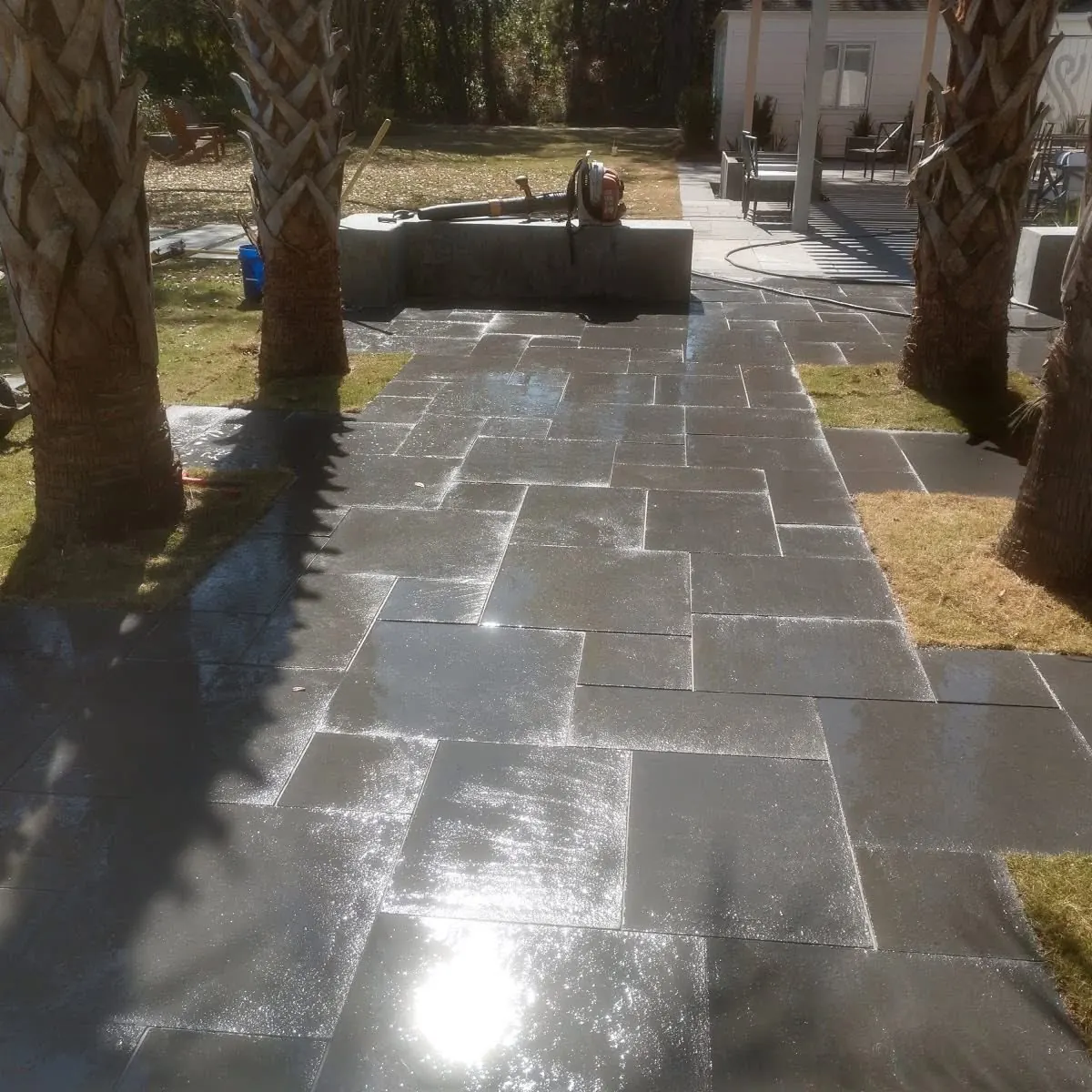
Choosing a hardscape material is really two decisions: what it should look like against your house, and what goes underneath it. The second one decides whether you are happy with it in ten years.
The Base Is the Whole Job
Everything that goes wrong with hardscaping comes down to two things: settling and roots. Both are decided before a paver is laid.
Our best method is to mortar-set pavers on a solid concrete base. Alternatives are a compacted ROC base with mortar on top, or sand and granite fines. #57 stone can replace ROC and brings a real advantage — the air gaps in it help stop tree roots growing up into the patio. Geotextile fabric goes underneath where the site calls for it.
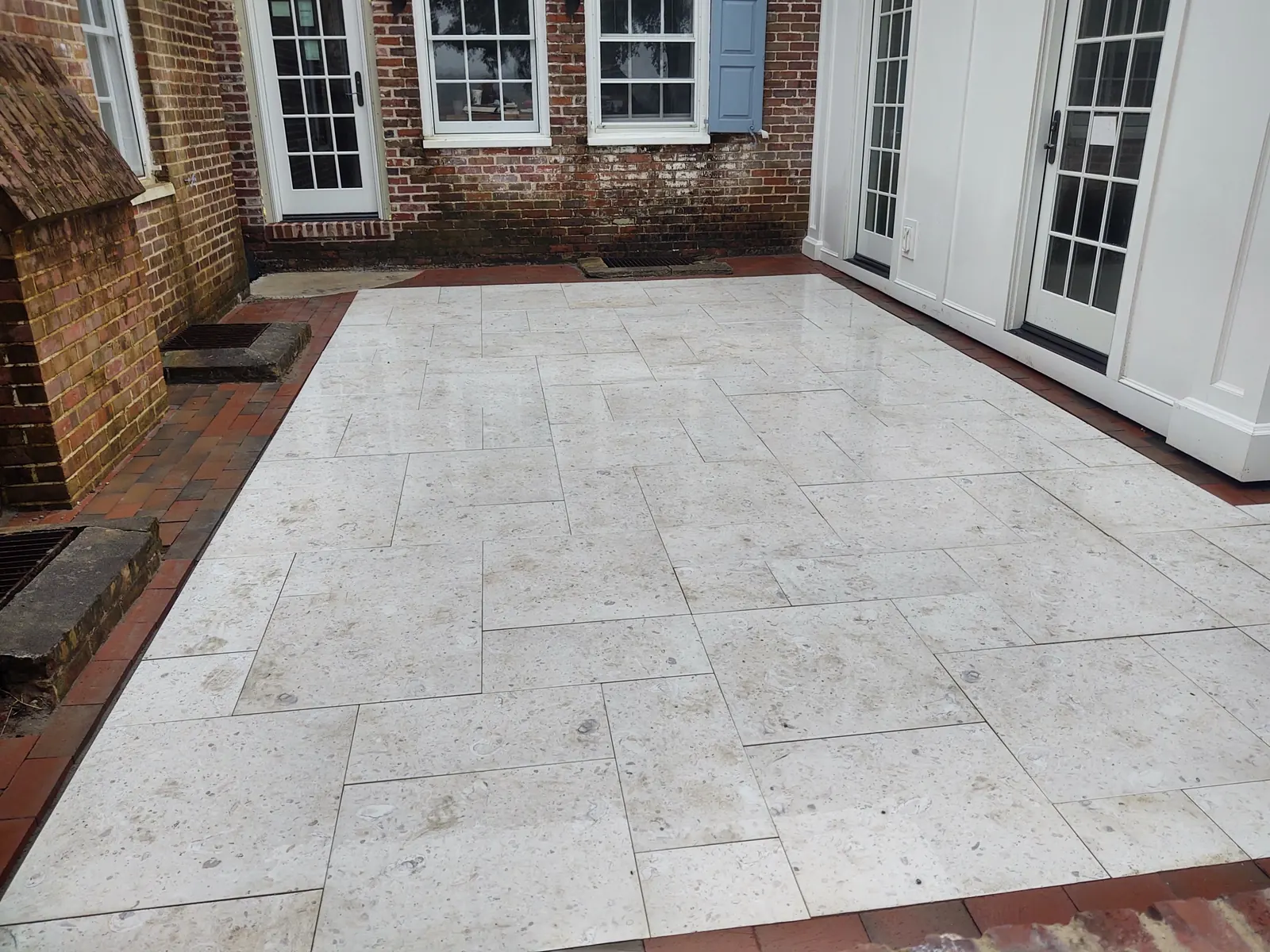
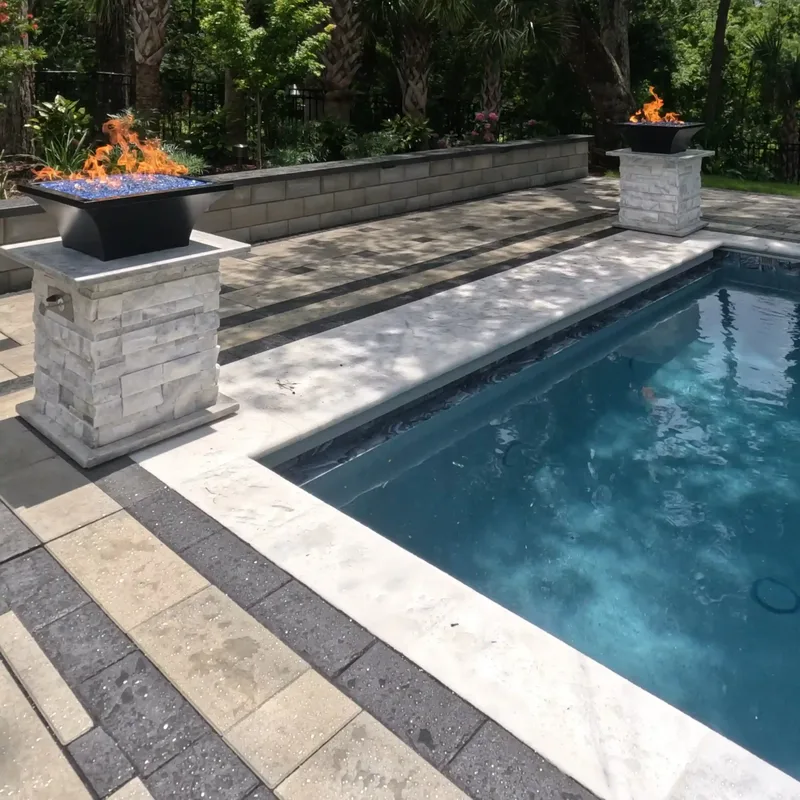
The Summerville marble patio here is mortar set over a concrete slab, which lets tile that already has a crisp edge be laid dead flat, every piece level with the next. It has a brick border, and the tile is imported from Italy.
The Materials, Honestly Compared
| Natural stone | travertine, bluestone, marble. Best looking, longest lasting, most expensive |
|---|---|
| Porcelain | cheaper than natural stone, strong and heat resistant |
| Concrete pavers | a wide range, cheap through pricey, huge choice of shapes and colors |
| Poured concrete | $12 per sq ft, the most affordable. Salt-void and tabby finishes look excellent |
| Pavers and turf | pavers set in a diamond pattern with artificial turf between them: a usable, low-maintenance patio that softens the landscape so it is not all stone or concrete |
| Brick | the Charleston default for borders, steps and walks, and it dates well |
Patios and pavers start around $18 per sq ft installed for pavers on sand. Mortar-set on a compacted ROC base is the middle, and marble, travertine or bluestone mortar-set on a concrete slab is the premium option, at $30 or more per sq ft.
Travertine is porous and hard to keep clean without a sealer, which is worth knowing before choosing it for a spot that sees red wine and pollen. We seal pavers occasionally, and we follow the manufacturer’s specification for the process rather than a rule of thumb.
Marble can bleach out under direct sun.
Two Things Charleston Adds to the Decision
- Permeable pavers are becoming a necessity. Lowcountry towns are getting stricter about how much impermeable surface a property can have, so a large patio or driveway needs that planned in rather than discovered at permitting.
- Drainage is part of the hardscape, not an afterthought. Proper grading, and drain basins with piping where the water needs carrying off. Where a pool deck meets the house, a channel drain along that junction is often necessary.
For gravel walks and around stepping stones we commonly use rock glue, which keeps the stone where it was laid.
Match the House, Not the Showroom
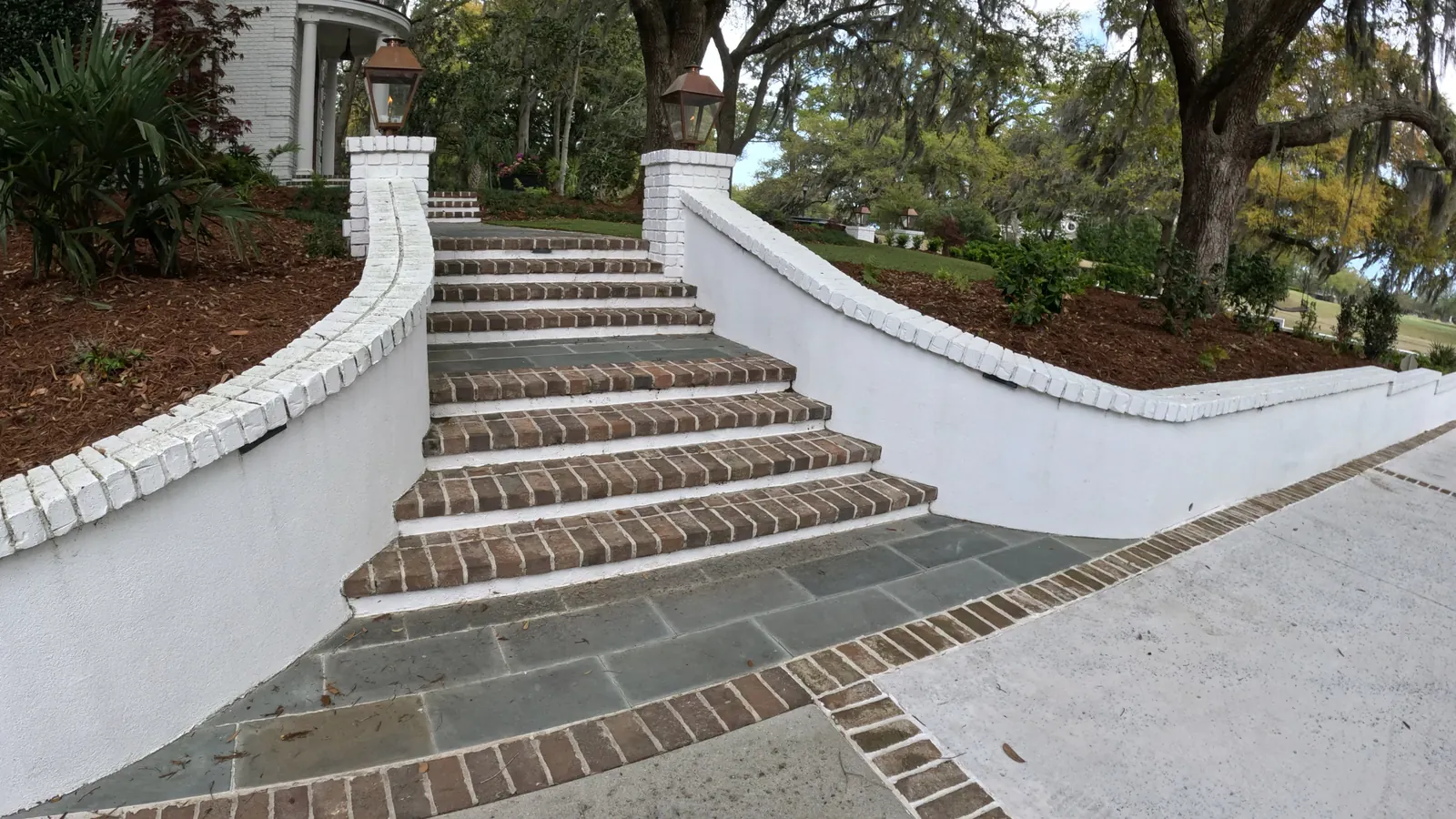
The material that suits a Charleston single house is rarely the one that photographs best in a catalog. Brick borders, bluestone walks and stucco walls with brick caps read as though they have always been there, because locally they have.
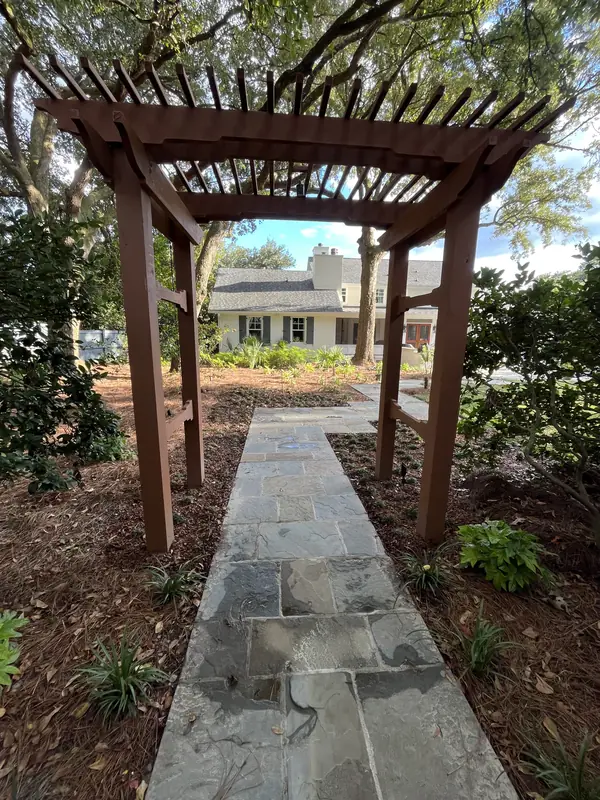
On this front yard the walls and steps take up the grade, and the bluestone walk with a brick border ties the steps to the drive. Nothing about it announces itself, which is the point.
What the Code and the Industry Standard Say
2021 IRC R401.3 · Paving next to the house
Any paved surface within 10 feet of the house has to slope at least 2 percent away from it — about a quarter of an inch per foot.1
South Carolina did not modify this section.2
2021 IRC R311.7.5 · Steps, with a South Carolina change
Steps that serve the house, off a porch, a door or a deck, are limited to a 7¾-inch riser, with treads at least 10 inches deep. South Carolina amended the riser rule so masonry steps may rise up to 8 inches. Within any one flight the tallest riser can be no more than ⅜ inch taller than the shortest.1,2
Free-standing garden steps are generally not regulated the same way; the building department decides which steps count.
2021 IRC R317.1 and R703.7.2.1 · Where a patio meets the house
A patio built up against the house has to stay below the walls. Wood siding, sheathing and framing need at least 2 inches of clearance above a patio slab or similar surface exposed to the weather, and 6 inches above soil, unless the wood is naturally durable or preservative-treated. On a stucco house the weep screed, where water drains out of the wall, has to sit at least 2 inches above paving and 4 inches above earth.1
South Carolina did not modify either section.2 That is why a new patio often steps down from the door rather than running level with it.
If you are comparing a quote for sand-set pavers, the Interlocking Concrete Pavement Institute's construction guide is the yardstick. It calls for a compacted aggregate base of at least 4 inches under patios and walks on well-drained soil, and 2 to 4 inches more on continually wet or weak soil. It asks for the subgrade to be compacted to at least 98 percent of standard Proctor density, for the bedding sand to be screeded to about 1 inch, and for that sand never to be used to make up for an uneven base.3 Those are minimums for a flexible, sand-set pavement; a mortar-set installation on a concrete slab is a different and stiffer system.
References are to the 2021 edition South Carolina enforces today; the 2024 edition takes effect statewide on January 1, 2027. Your local building department decides how any of it applies to a particular property.
Sources
- UpCodes, South Carolina Residential Code 2021, based on the 2021 International Residential Code. Source
- SC Building Codes Council, 2021 South Carolina Code Modifications (State Register Vol. 46, Issue 5, May 27, 2022). Source
- Interlocking Concrete Pavement Institute, Tech Spec 2: Construction of Interlocking Concrete Pavements. Source
Frequently Asked Questions
What is the best base for a paver patio in Charleston?
Mortar-setting the pavers on a solid concrete base is our best method. Alternatives are a compacted ROC base with mortar on top, or sand and granite fines. #57 stone can replace ROC and helps prevent tree roots because of the air gaps in it.
Why do patios settle or crack?
Settling and roots, and both come back to base preparation and compaction. Doing it right the first time and using a root barrier where needed is the fix.
Which hardscape material lasts longest?
Natural stone — travertine, bluestone and marble. It looks the best and lasts the longest, and it costs the most. Poured concrete is the most affordable, and salt-void or tabby finishes look great.
Do pavers need sealing?
Occasionally, and we follow the manufacturer specification for the process and maintenance. Travertine is porous and hard to keep clean without a sealer.
Do I need permeable pavers?
Increasingly, yes. Lowcountry towns are tightening limits on impermeable surface, so it is worth planning for on any large patio or driveway.
Does marble fade outdoors?
It can bleach out under direct sun.
See It Built
Projects where we put this into practice.
Planning a Project of Your Own?
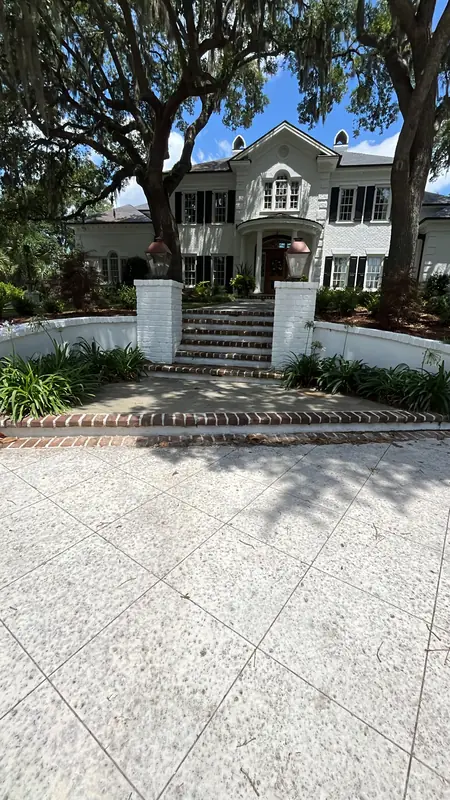
See everything we design and build, or get in touch to talk through your ideas with Doug and Zach.